Zonta Club of Vienna Parking provides bags for women in need

Due to the last lockdown in Austria, the Zonta Club of Vienna Parking extended the Zonta Says NO campaign. On 20 and 21 December, a pop-up charity store turned numerous donated bags into money under the motto “Bags Help Women.”

The club raised a respectable 4-digit sum for the violence prevention project StoP – Neighborhoods without Partner Violence in Vienna. StoP is a neighborhood project to prevent partner violence and domestic violence. It has a proven track record of success in Germany over many years, and the Autonomous Women’s Shelters Association in Vienna has coordinated the project since January 2019.

The club chose to support the StoP project, as women and children, in particular, are disproportionately affected by domestic violence. They collected bags of all kinds for the pop-up store over several weeks. The charity store accepts any handbag as long as it is intact and well-maintained. Well-known brand-name bags were especially welcome as they’re always in demand and can be sold for a lot.

The club would like to thank Boutique Hotel Altstadt Vienna and its team for their generous support for the event.
In the news: Birmingham women’s group seeks to fight human trafficking

image.pngPhoto courtesy of the Zonta Club of Birmingham

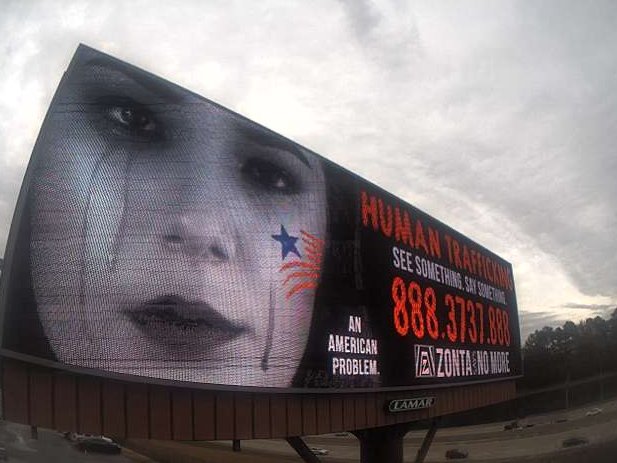
The Zonta Club of Birmingham recently put up this billboard on I-65 South at Exit 250 to draw attention to the problem of human trafficking, especially in the run up to The World Games 2022 in Birmingham in July.
Birmingham has a reputation as a major center for human trafficking, according to law enforcement and other officials.

This is true in part because the city is at the center of several major transportation routes — I-20, I-59 and I-65.

I-20 has often been dubbed a sort of “superhighway” for human trafficking.

Now a women’s group in the area with a long history of concern over trafficking and women’s issues has put up a billboard on I-65 to draw attention to the problem.

The Zonta Club of Birmingham put up the billboard on I-65 South at exit 250 on Dec. 4, and it will remain up until Jan. 2, club member Jean Bouler told Iron City Ink. 
The billboard contains the message, “See something. Say something,” meaning that citizens should report what they consider suspicious activity, and has a phone number, 888-373-7888.

“The billboard is in response to the The World Games 2022 in Birmingham,” Bouler said.

The World Games will take place in the Birmingham area July 7-17 this year and is expected to draw about 100,000 visitors to the city from all over the world.

Club members are concerned that The World Games could cause a uptick in demand for sexual trafficking.
Other officials have expressed a similar concern, including Birmingham Mayor Randall Woodfin.

“An increase in tourists seeking entertainments, including commercial sex, increases the potential risks for exploitation and human trafficking,” Woodfin said in December 2019, according to a report at Birmingham Watch.

The Zonta Club of Birmingham will also host a virtual program about the issue, “Human Trafficking: An American Problem,” on Jan. 11, 11 a.m.-1 p.m.   

The program will be led by Amy Wagar, a human trafficking survivor advocate and trainer in Birmingham.
To register, go to Eventbrite.

The Zonta Club of Birmingham was started in 1940 by professional women who were not allowed to join the then male-only Kiwanis and Rotary clubs. The goal is to empower women through service and advocacy.

Zonta of Birmingham has long been aware of human trafficking because it is a major issue with Zonta International, Bouler said.

The international organization has chapters in 63 countries and works with the United Nations to provide financial support and technical assistance to women and children in developing countries.

The local club has about 35 members and taken on the issue of human trafficking in the past, sponsoring programs, speakers and posters in restaurant restrooms, Bouler said.

For several years, the club has funded billboards in Birmingham with the message, “Say No to Violence Against Women.”  “We also support the YWCA women’s shelter and are hopeful that the billboard message helps,” Bouler said.  

The club also promotes women’s issues online, said club member Alison Smith.

https://ironcity.ink/neck-of-the-woods/birmingham-women%E2%80%99s-group-seeks-to-fight-human-trafficking/

Key West Palm Trees Go Orange

Every November, the Zonta Club of Key West, USA, goes orange to support the Zonta Says NO campaign to end gender-based violence. The club decked out palm trees with orange ribbons along North Roosevelt Blvd, Key West, to commemorate the International Day for the Elimination of Violence Against Women on 25 November.

The ribbons included information cards about the Zonta Says NO to Violence Against Women initiative to get more people not to look away but to speak up and take action, and get involved in their community. The club hung the orange ribbons during the 16 Days of Activism Against Gender-Based Violence from 25 November to 10 December, International Human Rights Day.

Residents and visitors of Key West were encouraged to support the campaign by wearing orange during the 16 Days.

The club strived to raise awareness and promote open discussions to help end violence against women and eliminate the detrimental consequences this violence has on the well-being of their community, including women, partners, children – One Family.

The Key West Commission presented the annual proclamation to the club in recognition of 16 Days of Activism, permitting the display of the orange ribbons.

Zonta Club of Bad Bergazabern brings orange to their community

To kick off the 2021 Orange The World campaign, the Zonta Club of Bad Bergzabern, Germany, lit up the Bad Bergzabern castle in orange on 25 November. 

Club members positioned themselves in front of the castle, dressed in orange and holding orange umbrellas. Club president Susanne Faber opened the event with a minute silence in memory of the 139 women who had been killed by their current or former partners in Germany this year, followed by a short speech in which she addressed the many existing forms of violence against women. 

Several local officials joined Susanne in speaking up against violence against women. They later talked with the interested visitors, who were also dressed up in orange, showing their solidarity gathered around. Many other prominent buildings in the area lit up in orange that same evening to show their support for the campaign: The German Wine Gate (Schweigen-Rechtenbach), Dionysius Chapel (Gleisweiler) and the Museum of Annweiler, for example, as well as Landeck Castle, Town Hall and St. Nicholas Chapel (Klingenmünster). 

“Our dream for the future is to have the complete Southern part of the German Wine Street illuminated in orange someday,” Susanne said when closing her speech.

In the news: Zonta Club of Cape Girardeau Makes Donation to Safe House of Southeast Missouri


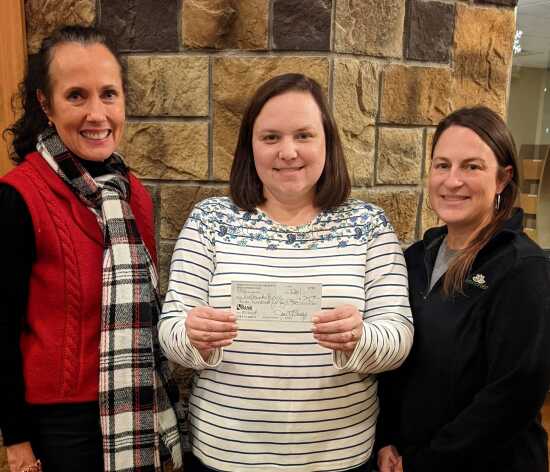
Zonta Club of Cape Girardeau recently donated $1,000 to Safe House of Southeast Missouri to support a project designed to help local healthcare providers safely refer victims of domestic violence to the Safe House for services. The project will focus on providers in Cape Girardeau, Bollinger and Scott Counties.

Zonta Club of Cape Girardeau is part of Zonta International, a leading global organization of professionals empowering women worldwide through service and advocacy.

Pictured are Dr. Cheryl Mothes, Zonta Club of Cape Girardeau Advocacy Committee Chair; Jessica Hill, Safe House of Southeast Missouri; and Dr. Heather Cugini, Zonta Club of Cape Girardeau and Southeast OB/GYN at Women First.

https://www.semissourian.com/story/2923463.html

Zonta Club of Denver educates patrons

The Zonta Club of Denver, USA, partnered with The Blue Bench (TBB) and the Novel Strand Brewing Company on 3 December to promote Zonta Says NO and educate patrons about violence against women. 

Since the beginning of 2021, the club’s advocacy, service and public relations committees partnered with TTB to create a poster to raise awareness of sexual harassment and assault. TTB is one of the club’s service award winners. TBB’s Safe Bars Project trains staff in establishments that serve liquor how to recognize and respond to sexual harassment and assault incidents. 

The posters are displayed in 10 Safe Bar trained businesses and they offer information about consent and safety along with phone numbers and a Quick Response (QR) Code for access to sexual assault and domestic violence resources available. 

Additional establishments are scheduled to receive posters and training in 2022.

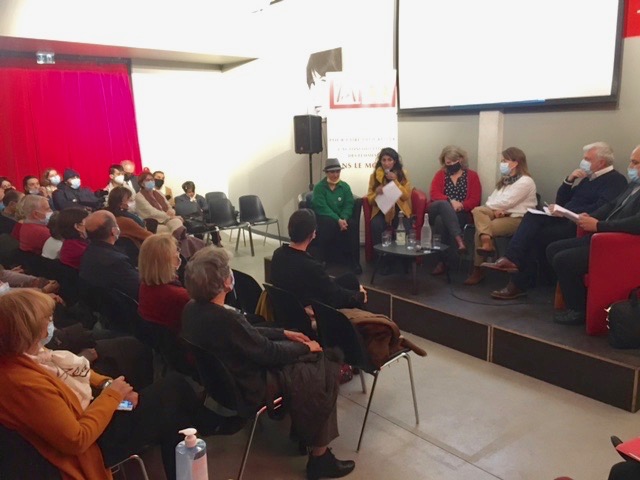
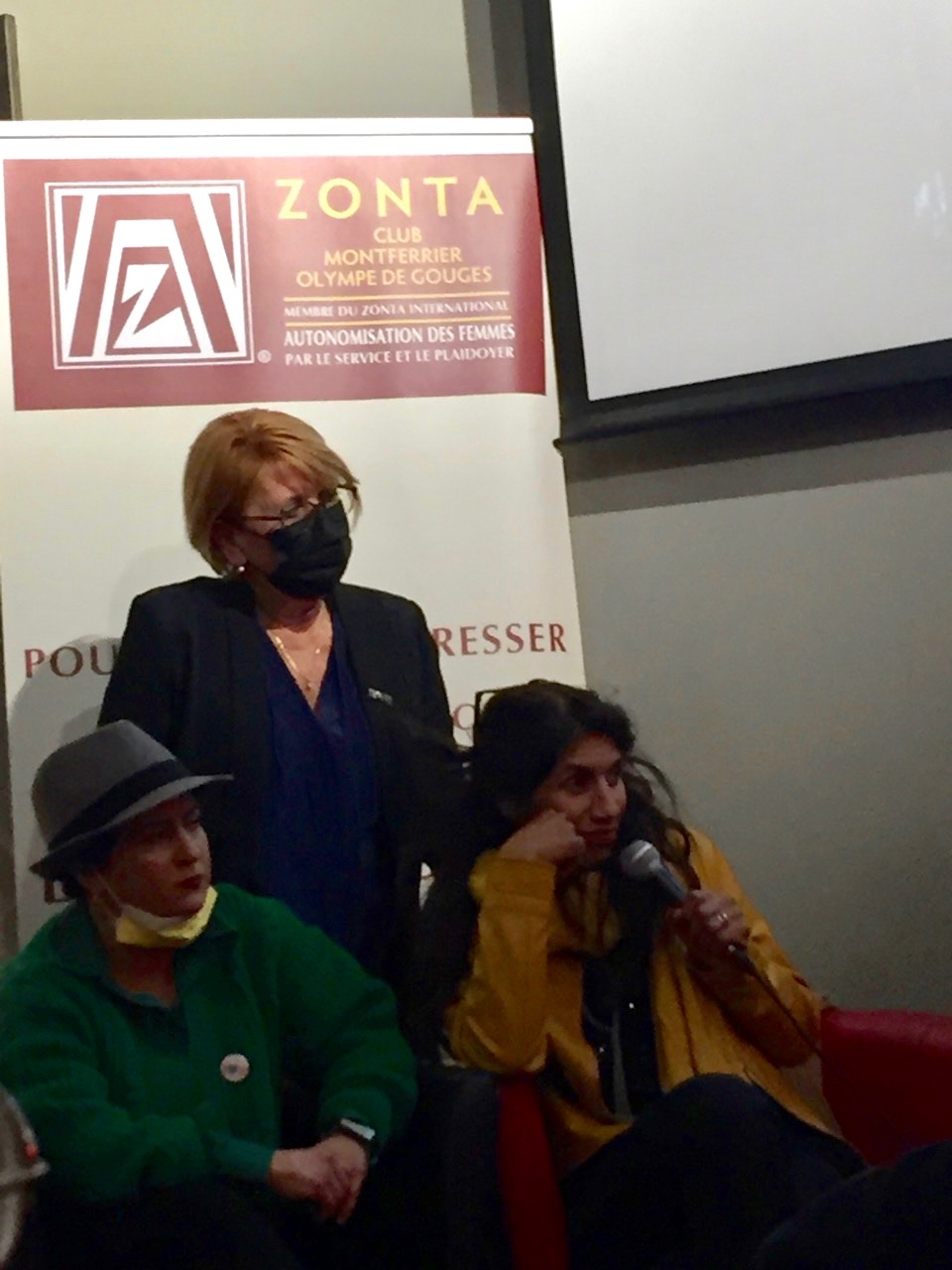
Zonta Club of Montferrier Olympe De Gouge holds round table discussing domestic violence

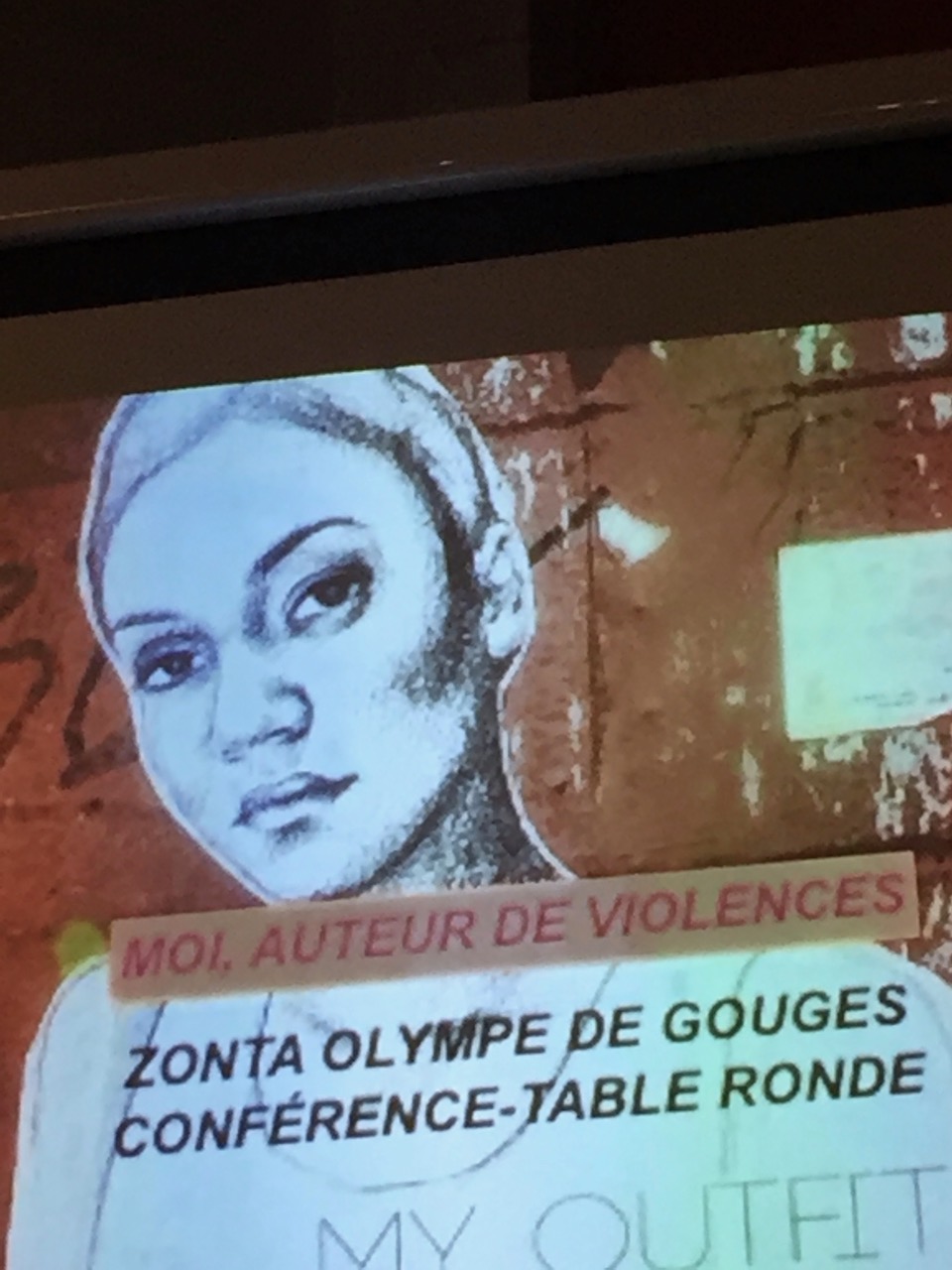
The Zonta Club of Montferrier Olympe De Gouges, France, recently held the screening of their project film Moi Auteur de Violence. Director Hélène Polsky will open a round table where legal professionals and organizations supporting female survivors of domestic abuse discuss and consider solutions to ending gender-based violence.

The club welcomes and collects testimonies from female survivors, which is a priority. However, they ask how we can anticipate violence and prevent acting out and recidivism?

Zonta Club of Ottawa, Canada shares its 16 Days of Activism YouTube campaign

The Zonta Club of Ottawa, Canada, participated in the 16 Days Campaign to end gender-based violence with social media messages to raise awareness of issues of violence against women and girls. The club wanted to mark the 16 days in a way that might resonate with the community. 16 club members made a difference by speaking out on an aspect of violence against women and children that is particularly meaningful to them.

Listed below is a list of topics the club presented for each of the 16 Days, along with a video.

Day 1, 25 November
Violence By Intimate Partners, presented by Judith | video


Day 2, 26 November
Sex Trafficking of Women and Girls, presented by Val H. | video


Day 3, 27 November
Affordable Housing for Women Fleeing Violence, presented by Elspeth | video


Day 4, 28 November
Financial Cost of Gender Violence to the Canadian Economy, presented by Kathleen | video


Day 5, 29 November
Impact of Domestic Violence on Children, presented by Sylvie | video


Day 6, 30 November
White Ribbon Campaign, presented by Kirsten | video


Day 7, 1 December
Workplace Violence and Harassment, presented by Lauren | video


Day 8, 2 December
Violence Against Women Parliamentarians, presented by Judith | video


Day 9, 3 December
Three Initiatives to Help Victims of Gender Violence, presented by Elspeth | video


Day 10, 4 December
Violence Against Indigenous Women, presented by Kathleen | video


Day 11, 5 December
Honor-Based Violence, presented by Val | video


Day 12, 6 December
Anniversary of the Montreal Massacre, presented by Susie | video


Day 13, 7 December
Story of Two Women Murdered by Intimate Partner, presented by Kathy | video


Day 14, 8 December
Resolving Not to be a Silent Bystander, presented by Elspeth | video


Day 15, 9 December
Evidence-Based Solutions to End Gender Violence, presented by Kathleen | video


Day 16, 10 December
What We Can Do to Stop Violence Against Women and Girls, presented by CJ | video

Zonta Club of Mannheim Oranges the World in Mannheim, Germany

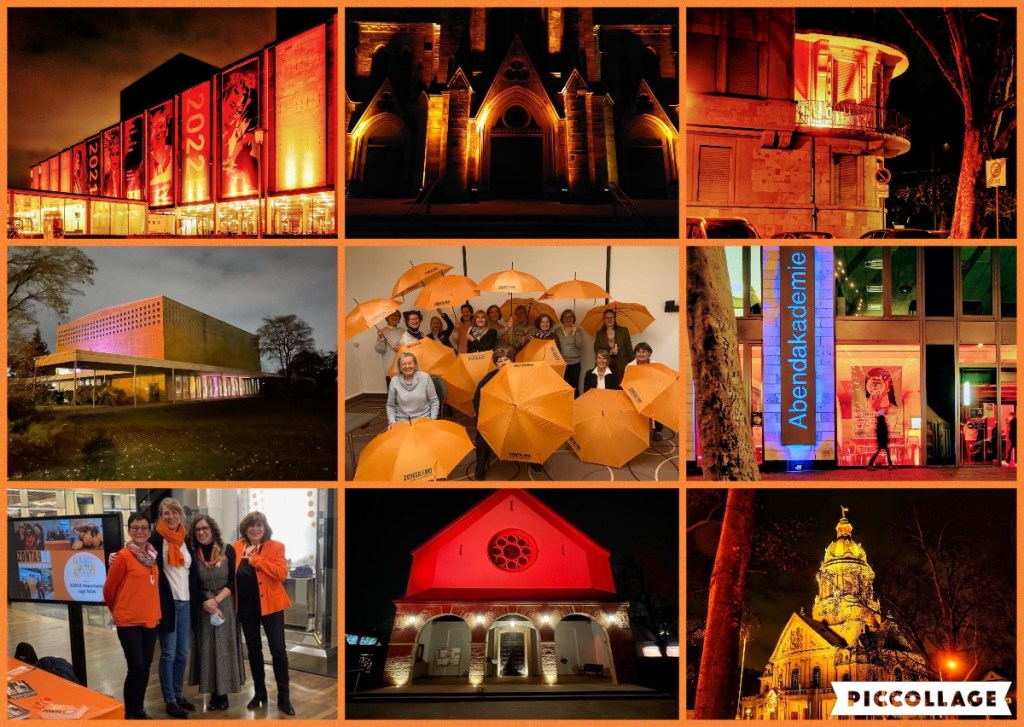
Starting in September, the Zonta Club of Mannheim, Germany, began organizing their Orange the World activities. More than 40 buildings and organizations participated in the event on 25 November by illuminating the buildings, hanging up posters and distributing information against violence against women. 

Visit the club’s website to see pictures and a short movie about the illuminated buildings.

In the news: Facing domestic violence; abusive situations aren’t always as they appear  


Inge Simmerman with one of her signs at Route 5 and East Main Street in Amsterdam on Thursday.PHOTOGRAPHER: PETER R. BARBER | Inge Simmerman with one of her signs at Route 5 and East Main Street in Amsterdam on Thursday.

Candy Gurtler doesn’t match the image that most people picture when they think about domestic violence. Neither does Jennifer Jennings or LisaMarie Soudelier. In fact, their experiences of domestic violence don’t match common conception, either. These women weren’t necessarily bloodied in brutal beatings; they weren’t threatened with weapons. But that doesn’t make what they went through any less awful. 

Their experiences represent the complex, pixelated image of domestic violence — and that lack of clarity is exactly why the issue can be so difficult for many people to truly comprehend. It’s a dynamic that awareness campaigns like Zonta International’s 16 Days of Activism Against Gender-Based Violence are hoping to address, bringing to light a situation that has been referred to as the “shadow pandemic,” even as police response data, when taken purely at face value, cut against that narrative.   

“If there is one thing in the community that I could change related to domestic violence, it is the image that pops in everyone’s head when you say ‘domestic violence,’” Gurtler said. “That image is a woman with a black eye. That is not domestic violence. It could be. But there is so much more to it.” 

Gurtler, who works as the non-residential advocate at The Family Counseling Center in Gloversville, knows from her own experience. She said she is 13 years removed from a 13-year abusive relationship with another woman. There was no single defining argument during which it all came crashing down, Gurtler said. Rather, Gurtler said, she experienced an erosion of her own self-worth. 

“You’re a terrible person, you’re stupid. When you hear these things every single day, it weakens you. It takes all the strength and resolve that you have, and it makes it very difficult for you when you do leave to be successful.”

Zonta International, a global organization of professionals empowering women worldwide through service and advocacy, is hoping its recent campaign, which ended Friday but is still evidenced locally by orange signs around Schenectady, Montgomery and Fulton counties, can help limit the amount of women who have to go through what Gurtler and too many others have gone through by spotlighting domestic violence and human trafficking.  

“We use that period of time to make people aware in their own communities, in their own towns, that this is an issue,” said Inge Zimmerman, Advocacy Chair of the Zonta Club of Montgomery-Fulton, who noted that domestic violence doesn’t discriminate against race, socioeconomic status or anything else. “Violence against women is not something that is arm’s length away. It is happening to our neighbors, it’s happening to our family members.”
 
Numbers don’t lie–but they also don’t tell the whole story
And yet, if you look at law-enforcement response numbers, you’d be tempted to think that domestic violence is on the decline — or at least not escalating. 

In Montgomery County, law enforcement responded to 282 cases in 2017, 245 cases in 2018, 195 in 2019 and 219 in 2020, according to numbers from New York State’s Division of Criminal Justice Services. Meanwhile, Fulton County saw 567 and 572 cases in 2017 and 2018 compared to just 378 cases in 2020, according to the state. In Schenectady County, the numbers have held relatively steady, with 1,420 domestic violence incidents in 2017 compared to 1,435 in 2020, the data show.   

These numbers are surprising, even to those in law enforcement. 

“On paper it doesn’t seem to have risen. I can definitely tell you that I was surprised,” said Fulton County Sheriff Richard C. Giardino. His jurisdiction responded to 298 domestic violence calls in 2019, 249 in 2020 and 259 in 2021 as of the first week in December, according to numbers supplied by Giardino. “Intuitively, I would say with people locked up in the house together there are going to be more cases, but that’s not what we’ve seen.”

Police and advocates say there could be many explanations for the numbers not matching the reality. It could be that people experiencing abuse don’t have an opportunity to call for help when their abuser is in such close proximity, said Jennings, the Family Counseling Center’s Director of Marketing and Fund Development. It could be because the pandemic has caused financial strain for a lot of people, making victims feel like now is not the time to break free, said Soudelier, The Family Counseling Center’s domestic violence shelter coordinator. It could even be because bars have been closed or at reduced capacity during the pandemic, thus giving rowdy abusers less opportunity to rile each other up, said Sheriff Giardino. 

To be sure, some jurisdictions have seen a climb in cases. For example, the Montgomery County Sheriff’s office fielded 672 domestic dispute calls in 2019 compared to 793 in 2020 and 744 as of the first week of December this year, according to Sheriff Jeff Smith. He said violence has been up across the board during the pandemic, and he thinks an increase in digital communication could be a major contributing factor. 

“Road rage, neighbor disputes, disorderly conduct in general,” Smith said. “We don’t know for sure why, but maybe the fact that people don’t have as much interaction with other people and they are more secluded. Maybe they’ve lost a little bit of compassion and patience in dealing with other people.” 

The fact that numbers can go up in one jurisdiction and not in a neighboring county points to why addressing domestic violence can be so vexing, advocates say. 

“I think the downward trend is a red herring,” said Zonta’s Zimmerman. “If anyone thinks, oh, great, the numbers are going down, that’s not true. If you are in lockdown, do you really think this is the time you are going to report him for beating you up?”  
 
Finding a way out
Advocates explain that getting out of a domestic violence situation is never easy. 
For many, leaving a family is not the way they were raised. 

“Culture has a very large bearing,” Soudelier said. “For instance, I’m Hispanic. In the Hispanic culture, you don’t leave your husband, you don’t leave your home, you don’t leave your children. You are there to take care of your children, take care of your house. Divorce is not an option — doesn’t matter how he is treating you.”

Many conservative cultures prevalent in rural areas often have a similar set of values, Jennings said. 

A huge part of the problem is that the onus to escape falls on the people being abused, almost always requiring them to uproot their lives by leaving their home, often with kids in tow. Then there are jobs to worry about, legal action to take and a constant fear of retaliation. 

“Trying to get out of a domestic violence situation has so many layers of complexity,” Jennings said. “The impact on your livelihood, your safety and shelter, your ability to take care of your children. There are a lot of complex issues that go into someone deciding whether or not to flee their situation.”

If a situation is so physically violent that it’s dangerous, the decision to leave can be clear. But it’s commonly not so obvious, advocates say. That’s because many situations of abuse actually begin with “love bombing,” meaning the abuser is initially sweet, showering the eventual victim with kindness before the situation gradually darkens, according to Jennings. That creates confusion and doubt for the person who is being abused, she said. 

Adding to the difficulty is the fact that court orders of protection don’t always get served immediately. And police response, especially in rural areas, can take time, Gurtler said. 

“I have clients waiting weeks to get the person who is abusing them served,” Gurtler said. “In the meantime, the person is just sitting there, and they have no protection. I can tell you right now I have a client that’s been waiting five days for her order of protection to be served, and she said to me what’s going to be [the police’s] response if [the abuser] does come to me? It takes [police] 45 minutes to come to my house.” 
The pandemic has only hindered the system’s ability to respond, Gurtler said.

Shelters like The Family Counseling Center’s safe dwelling, which can house up to nine residents, have been operating at full capacity, with social distancing requirements complicating where beds can be placed. And because of eviction moratoriums, people who come to shelters are having more trouble securing housing, prompting them to stay in a shelter longer, Gurtler said.  

What’s more, the pandemic has complicated school situations, with bus driver shortages making it harder to find transportation, Gurtler said.  

“So a lot of [people being abused] are electing to stay in their situation because their kids have their own beds and they don’t have to worry about how they are going to get to school,” Gurtler said. 

Help is here 
The good news is that people who are being abused don’t need to feel like they are alone. Resources like The Family Counseling Center are available to provide support. If you’re in trouble, call the 24/7 hotline (518-725-5300). If there isn’t a spot at the safe dwelling facility, The Family Counseling Center’s staff will help you find a place at a different facility. 

At the safe dwelling shelter, where food, clothing and personal hygiene products are provided upon admission, case managers meet with clients daily. Meanwhile, children are transported to their school, or else they are enrolled in a school near the shelter. 

“The day [abuse victims] come in and sign all this paperwork, they are often in shock,” Soudelier said. “What’s going on with my life? What has happened? I usually give them a day or two so they can have time to process.”

Then the work begins. Clients are allowed to stay at the shelter for 90 days, during which time they are helped with everything from job training to finding housing. 

“Abuse does not happen in a set pattern,” Jennings said. “Every victim of abuse that comes to us is unique. You can’t have a checklist. We know what we need to do to help them, but the order and how is always unique to the individual.”

Once housing is secured, The Family Counseling Center stays in touch, whether the client needs help finding furniture or fighting for their rights in court. 

“Whatever it is that you need to do to become safe, we do it with you so you don’t have to do it by yourself,” said Gurtler, who also helps clients who never spend time at a shelter. 
 
Warrior mentality
It is a sad truth that many people who are abused once often find themselves back in abusive situations, advocates say. 

Gurtler said people who are abused are often targeted because they are amazing people. 

“People who are abusive know what to look for when choosing their next victim. They are looking for someone who is nurturing because they need someone to take care of them. They want someone to take all the responsibility for their poor choices,” Gurtler said. “You have all these positive characteristics about you. That’s why he found you.”

Learning to recognize these strengths and feel deserving of love can be a long struggle, advocates say. Especially when triggers of trauma lurk everywhere. Soudelier said she remembers a time long after she had left her abusive relationship when she dropped something and immediately grabbed a bucket and sponge rather than a mop. That’s because her abusive partner used to make her get on the floor to clean.  

“The person would say ‘you don’t know how to use a mop. Get on your hands and knees.’”

Soudelier said when she got the sponge and bucket, her current partner questioned it. She explained that the hands-on cleaning method had been so deeply entrenched in her mind that her response was subconscious. 
“It’s just there,” Soudelier said. 

Moving past abuse takes time, but it’s doable, say advocates. And as Jennings points out, choosing to get help is actually the opposite of being a victim. 

“The people who are coming to us seeking help, they are trying to self-advocate, and that is not a victim mentality. That is a warrior mentality,” Jennings said. “That’s someone who is taking control and doing as much as they can.”

Gurtler said she doesn’t like to refer to herself as a victim or even a “survivor.”

“I considered myself “healed” because I did the work. I don’t have any of those triggers anymore,” she said. “But it takes work. And you have to recognize when these things are happening so that you can work through them.”

Often, the first sign of progress is small. A “crack,” Jennings called it. It could even be a smile. 

That’s what happened for Gurtler. She said she didn’t even realize how dark her relationship had become until she finally left it and was interacting with a colleague. 

“Somebody at work said to me this is the first time I’ve ever heard you laugh.” 

https://dailygazette.com/2021/12/12/facing-domestic-violence-abusive-situations-arent-always-as-they-appear/